
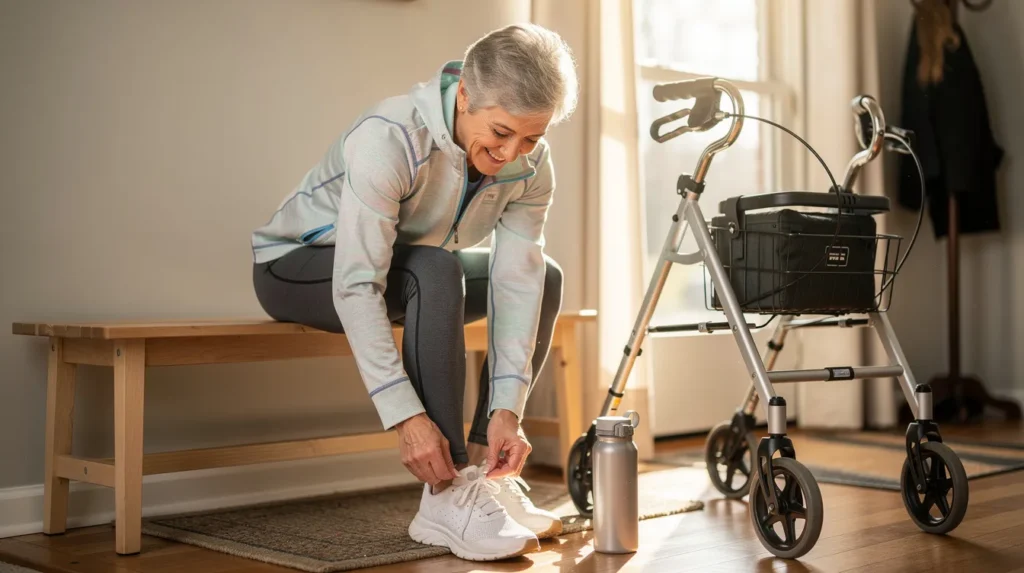
“I’ll start Monday.” Sound familiar? You buy the shoes, you download the app, you might even pay for the membership — and then Monday arrives, and somehow the couch wins again. If you’re someone who procrastinates going to the gym, you’re in very good company. Research suggests that most people who set exercise goals abandon them within weeks, and the number one culprit isn’t laziness. It’s psychology.
At LIFEmed, we work every day with Canadians of all ages and abilities who want to move more — including seniors and individuals living with mobility challenges. Here’s what we’ve learned about why gym procrastination happens, and the practical steps that actually get people moving.
Why We Procrastinate on Exercise (It’s Not Laziness)
Procrastination is rarely about being lazy. Behavioural scientists describe it as an emotion-management problem: when a task feels overwhelming, uncomfortable, or intimidating, our brain seeks short-term relief by avoiding it. The gym checks every box for avoidance:
It feels intimidating. Walking into a room full of equipment you don’t know how to use — surrounded by people who seem to know exactly what they’re doing — triggers real anxiety. For seniors or anyone using a mobility aid, that intimidation can be even stronger.
The payoff feels far away. Exercise benefits build over weeks and months, but the discomfort is immediate. Our brains are wired to weigh “right now” far more heavily than “someday.”
All-or-nothing thinking takes over. We tell ourselves a workout only “counts” if it’s an hour long and leaves us drenched in sweat. When we can’t commit to that, we do nothing instead.
Physical barriers are real. Pain, fatigue, balance concerns, and limited mobility aren’t excuses — they’re legitimate obstacles that require the right plan and, sometimes, the right equipment.
The good news? Every one of these barriers has a workaround.
The Real Cost of Waiting
Before we get to solutions, it’s worth being honest about what procrastination costs — especially as we age. Extended sitting and inactivity are linked to muscle loss, reduced bone density, poorer circulation, stiffer joints, and higher risk of chronic conditions like type 2 diabetes. In fact, building consistent movement habits early is one of the most powerful prevention tools we have — something we explored in depth in our guide to building active lifestyles to reduce type 2 diabetes risk.
For seniors, the stakes are even higher. Inactivity accelerates the loss of strength and balance that keeps us independent. The encouraging flip side: it’s never too late to start, and even modest activity produces measurable improvements in strength, mood, and energy within weeks.
7 Ways to Beat Gym Procrastination for Good
1. Shrink the goal until it’s impossible to skip
Forget the one-hour workout. Commit to five minutes. Seriously — five minutes of walking, stretching, or light resistance work. The hardest part of any workout is starting, and a tiny goal removes the mental resistance. Most days, once you start, you’ll keep going. On the days you don’t, five minutes still beats zero.
2. Redefine what “the gym” means
The gym is not the only place fitness happens. Your living room, your driveway, a community pool, or a local walking path all count. Canada’s short, beautiful summers are perfect for this — our Summer Fitness Plan for seniors is packed with adaptive outdoor activities that don’t require a membership card at all.
3. Schedule it like a medical appointment
Vague intentions (“I’ll go sometime this week”) almost always lose to specific plans (“Tuesday, 9:00 a.m., 20-minute walk”). Write it in your calendar. Better yet, tell someone. Accountability roughly doubles follow-through.
4. Prepare the night before
Lay out your clothes, fill your water bottle, and put your shoes by the door. Every small decision you eliminate in the morning is one less opportunity for your brain to negotiate its way out.
5. Pair movement with something you enjoy
Save your favourite podcast or playlist exclusively for exercise time. This technique — called temptation bundling — turns “I have to work out” into “I get to listen to my show.”
6. Remove the physical barriers
If pain, balance, or mobility limitations are what’s really keeping you home, the answer isn’t willpower — it’s the right support. Standing frames, walking aids, power add-ons, and adaptive equipment can transform exercise from daunting to doable. Browse our full range of mobility and standing equipment to see what’s possible, from pediatric standers to heavy-duty wheelchairs built for active lifestyles.
7. Track streaks, not perfection
Missed a day? Fine. The rule is simple: never miss twice. A visible streak — checkmarks on a calendar work beautifully — builds momentum and makes consistency feel rewarding rather than punishing.
A Special Note for Seniors and Caregivers
If you’re a senior (or supporting one), gym procrastination often hides a deeper worry: fear of falling, overheating, or overdoing it. Those concerns deserve respect, not dismissal. Start with seated or supported exercises, stay hydrated, and choose cooler parts of the day for outdoor activity — our guide to staying healthy, hydrated, and active all summer long covers exactly how to stay safe while staying moving.
And always check with your healthcare provider before beginning a new routine, especially if you manage a chronic condition.
Stop Waiting for Monday
Here’s the truth every chronic gym procrastinator eventually learns: motivation doesn’t come before action — it comes from it. You don’t need to feel ready. You need five minutes, a plan, and maybe the right equipment to make movement feel safe and achievable again.
At LIFEmed, we believe quality of life is everything, and movement is at the heart of it. Whether you need adaptive fitness equipment, a stander, or simply guidance on where to begin, our team is here to help you take that first step — today, not Monday.
Ready to get moving? Explore our products or contact LIFEmed to find the right mobility solution for your active life.
To visit our Social Media, please click on Facebook and Instagram